
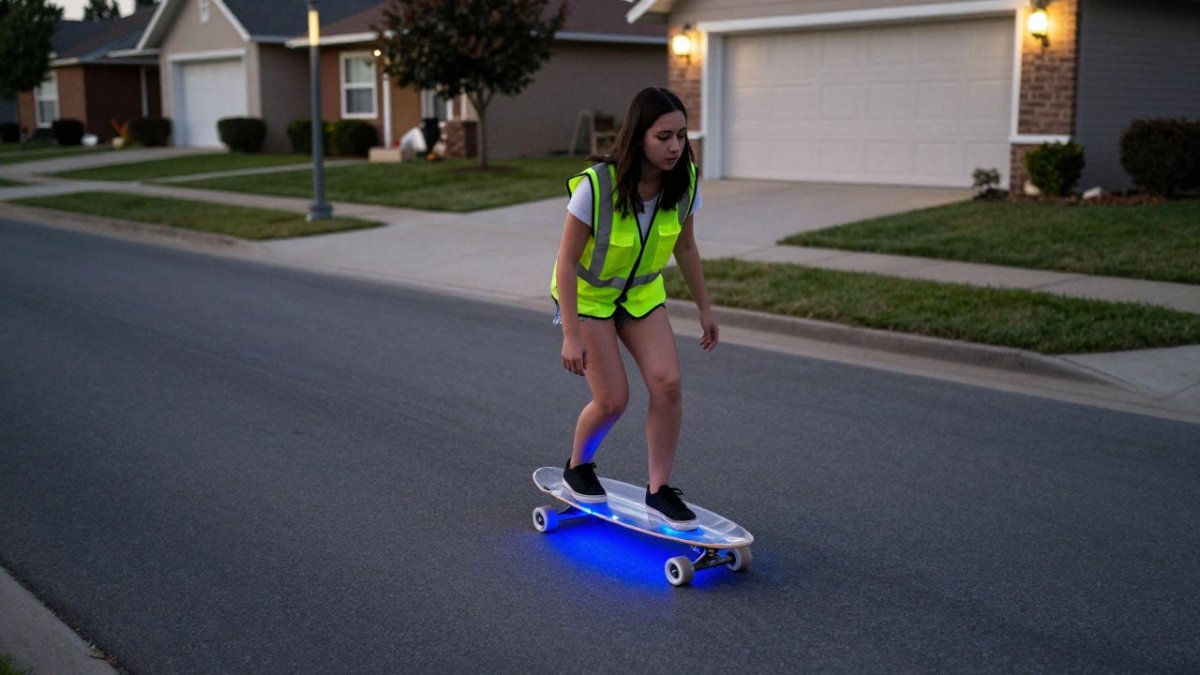
Quick Summary
The best tips for riding longboards at night start with planning: make yourself visible from every angle, light the path ahead, stick to familiar paved routes, and ride slower than you think you need to. Drivers see you later after dark, and your stopping distance stays the same while your sight distance shrinks.
- Layer your lights: a white front light, a red rear light, and wheel lights for side visibility.
- Carry a backup light or reflective vest in case a primary light fails mid-ride.
- Check every light’s mount before each ride, since vibration loosens clip-on lights.
- Treat your headlight beam as your speed limit and keep stopping within the lit distance.
- Check any new route in daylight first for potholes, grates, and blocked sight lines.
Table of Contents
- Why Night Longboarding Needs a Different Plan
- Longboard Lights for Night Riding: Building a Complete Setup
- How to Stay Visible on a Longboard After Dark
- Safe Routes for Longboarding at Night
- Longboard Pre-Ride Safety Check Before You Head Out
- Speed, Balance and Braking in the Dark
- Legal Rules, Etiquette and What to Do When Conditions Turn
- Your Next Night Ride: Starting Small and Building Confidence
- Frequently Asked Questions
Tips for Riding Longboards at Night: A Safe How-To
Last Updated: November 21, 2026
Why Night Longboarding Needs a Different Plan
Night riding on a longboard is a different sport than daytime cruising, so these tips for riding longboards at night start with planning. Drivers see you later, pavement hides cracks and debris, and your balance depends on what you can light up in front of you. Riders who want to get out after dark face this challenge, so the planning matters.
The biggest mistake is treating a night ride like a day ride with the sun turned off. Speed, braking, and route choice all need to change. A board that feels stable at noon can feel twitchy when you cannot read the surface ahead.
Here is the short version: be seen, be able to see, pick familiar ground, and ride slower than you think you need to.
Longboard Lights for Night Riding: Building a Complete Setup
A complete night setup has two jobs. It makes you visible to others, and it lights the path ahead of you. Most riders need both.
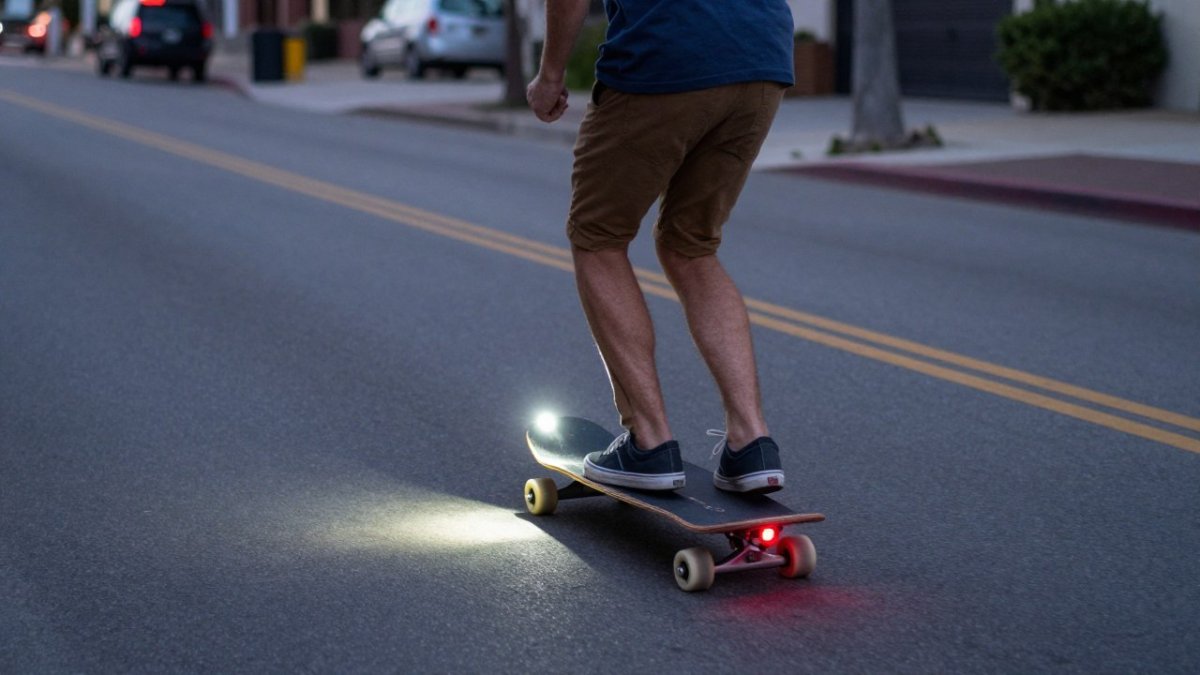
For the front and rear light, a helmet with a built-in rechargeable front light is a simple place to start. Keep any helmet light charged before every ride.
Add lights to the board itself as well, such as wheel lights, which can make the board easier to see from the side. Our guide to deck versus wheel lights, charging, and rain performance explains how each option holds up before you choose a board.
Watch out: Lights that run out mid-ride leave you exposed, so charge everything the night before.
Here is a quick summary of the lighting pieces a complete night setup needs.
| Item | Purpose | Note |
|---|---|---|
| Helmet front light | Lights the path ahead | Keep it charged before every ride |
| Wheel lights | Makes the board visible from the side | Spin and catch a driver’s eye at cross streets |
| Rear light | Lets cars behind track your speed | A light on your body helps if the deck light is blocked |
| Backup light or reflective vest | Keeps you visible if a light fails | Carry it in your pack |
How to Stay Visible on a Longboard After Dark
Visibility is about giving drivers and pedestrians time to react, and that means covering every angle a vehicle can approach from, not just the front. A single blinking light on your helmet leaves your sides and rear dark, and side visibility is what matters most at intersections and driveways where a car crosses your path.
Build the setup in layers:
- Front light (white). Mount it on your helmet or the front of the deck, aimed slightly down the road rather than straight ahead. Aiming it too high blinds oncoming drivers; aiming it too low shortens the distance you can read pavement. A helmet mount follows your head and shows drivers where you are looking.
- Rear light (red). Put it on your backpack, belt, or the tail of the deck so cars behind you can track your speed. A rear light on the deck sits low and can be blocked by your legs, so a second rear light on your body is worth the weight.
- Side visibility. Wheel lights are the simplest way to make the board visible from the side, because they spin and catch a driver’s eye at cross streets. You can get wheels that light up without batteries for this purpose. Reflective tape on the deck edges and trucks adds a passive layer that works even if a battery dies.
- Reflective clothing. Wear reflective material on your torso, ankles, and wrists, since those points move and draw attention. A dark hoodie with one dim light disappears against the road; reflective bands over a dark jacket do not.
- Passive backup. Carry a small backup light or a reflective vest in your pack. If a primary light fails mid-ride, you are not left invisible.
Mounting and security matter as much as the lights themselves. Before you push off, twist and tug each light to confirm the mount is tight, and check that no strap or clip is cracked. Vibration from rough pavement loosens clip-on lights over a ride, so re-check them at every stop. Route cables and straps so they cannot catch a wheel or your foot.
Watch out: A light that runs out mid-ride leaves you exposed, so charge everything the night before and carry a backup for your primary front light.
Finally, test the setup from a driver’s point of view. Have a friend sit in a parked car 100 to 200 feet away while you stand with your lights on, and confirm they can see you clearly from the front, both sides, and behind. Adjust mounting until all four angles read well.
Safe Routes for Longboarding at Night
Route choice matters more after dark than it does during the day. Following these tips for riding longboards at night, stick to paved surfaces you already know. Ride streets with working streetlights, wide shoulders, and light traffic.
Local paved paths are often a good choice. Local paved paths are a good choice, and your city’s parks or transportation department can point you to trails that are lit and maintained. For Utah County, see paved trails and scenic spots to longboard.
Before you ride a new route, check it in daylight first. Look for:
- Potholes, cracks, and raised pavement seams
- Drainage grates and loose gravel at the edges
- Parked cars that block sight lines at intersections
- Places where the path narrows or meets traffic
Longboard Pre-Ride Safety Check Before You Head Out
A quick check before every ride prevents most common problems. Run through this list:
- Helmet fits snugly and the front light is charged
- Rear light is on and secure
- Wheel lights are working
- Trucks and bushings feel tight, with no loose bolts
- Wheels spin freely and show no major flat spots or cracks
- Grip tape is intact and the deck has no splits
- You know your planned route and turnaround point
Do this check every time, even on a short ride, because it is one of the most useful tips for riding longboards at night. It takes about two minutes and catches the problems that cause crashes.
Speed, Balance and Braking in the Dark
At night your usable sight distance shrinks, and your stopping distance does not. That mismatch is the core risk of night riding: you can only ride as fast as you can stop within the stretch of pavement your light actually reveals. Treat your headlight beam as your speed limit. If the light reaches roughly 30 feet ahead, you need to be able to stop in less than 30 feet, and that is far slower than most riders assume.
A practical way to calibrate: on a flat, empty stretch you know well, ride at a comfortable speed and practice a controlled foot brake until you stop. Mark where you started and where you stopped, then measure the distance. Repeat at a slower speed. Most riders find their stopping distance at cruising speed is longer than they expected, which is why the first night rides should be slower than daytime cruising.
Reaction time adds to that distance. Even a fraction of a second of surprise at a pothole or a turning car translates into several feet of travel before you begin braking. Ride at a speed where you can scan the pavement, spot a hazard, and still stop with room to spare.
Balance is harder when you cannot read the surface. Keep your knees bent, your weight centered, and your stance wide. Make small turns and avoid sudden leans until you know the pavement. On dark, wet, or leaf-covered surfaces, reduce speed further and brake earlier and more gently.
Foot braking works best at low speed. Drag your back foot lightly and build pressure slowly, keeping your weight over the front foot. A common mistake is braking hard on a dark, wet surface, which can lock up the wheels and throw you off balance.
Watch out: Do not practice night braking in traffic. Learn the feel of a controlled stop on an empty, lit stretch first, then carry that speed judgment onto your route.
For a stable setup, a pintail cruiser is a common choice for controlled speed and steady braking. The Vibe Ride pintail cruiser is one option built for smooth, responsive riding. Practice these skills on flat, smooth ground before you try them on a night route, and keep your first night speeds well below what feels fast in daylight.
Legal Rules, Etiquette and What to Do When Conditions Turn
Local rules on longboarding vary. Check your city’s ordinances on riding in streets and on sidewalks, and confirm whether lights are required after dark where you ride.
Good etiquette helps everyone. Yield to pedestrians, ride single file in shared spaces, and keep clear of crosswalks.
Conditions can change fast. If rain starts, wet pavement cuts your braking power. If streetlights fail or fog rolls in, head home by the route you know best. Stop riding if you feel unsafe, and never push through a ride you are not confident in.
Your Next Night Ride: Starting Small and Building Confidence
Start with a short loop on a route you know well. Ride it a few times until your lights, braking, and balance feel automatic. Then extend your distance step by step.
Keep your first night rides relaxed and close to home, following the tips for riding longboards at night covered above. Confidence grows from repetition, not from pushing into unfamiliar streets.
When you are ready to build your setup, explore the Ghost Boards collection and use the custom board builder to plan a board that matches how you ride. For current prices or a quote, visit the Ghost Boards website.
Frequently Asked Questions
What lights should I use when riding a longboard at night?
Use a white front light that is visible from at least several hundred feet, and a red rear light so drivers behind you can see you. Many riders combine a clip-on or helmet-mounted headlight with a rear light and side reflectors or light straps for visibility from the sides. Choose lights with a rechargeable battery and a steady or flashing mode, and check them before every ride. Ghost Boards offers LED-illuminated board options, but any lights you add should still meet the basic front-white, rear-red rule. Confirm current specifications and availability directly with Ghost Boards.
How can I stay visible to drivers while longboarding after dark?
Combine lights with bright or reflective clothing. Wear light-colored or fluorescent layers, add reflective strips to your jacket, backpack or shoes, and keep your lights on the side that faces traffic. Ride where drivers can see you clearly, avoid dark side streets without street lighting, and make eye contact at intersections. Visibility is about how many angles you can be seen from, so light your front, rear and sides.
Is it safe to longboard alone at night?
It can be safer if you prepare well, but riding with a friend adds an extra set of eyes and a person who can help if you fall or your board fails. If you ride alone, stick to familiar, well-lit routes, tell someone your planned route and return time, carry a charged phone, and keep your speed conservative. Skip the ride entirely if the weather is poor or you feel unwell or fatigued.
How should I adjust my speed when riding a longboard at night?
Ride slower than you would in daylight. Reduced visibility shrinks the distance you can see hazards, so you need more time to react. Keep your speed at a level where you can stop or steer around a pothole, pedestrian or parked car within the distance your headlight clearly illuminates. Practice braking at low speed first, and leave extra space between you and cars, curbs and other riders.