

Last Updated: October 23, 2026
Quick Summary
Acrylic longboards durable for daily commuting require quality construction and proper maintenance, with durability depending on acrylic thickness, impact handling, and how you care for the board. Well-built acrylic decks commonly stay rideable for 500+ miles when inspected regularly and retired when cracks grow, edges separate, or stiffness is lost.
- Acrylic is rigid and transfers impact directly through the board, unlike maple which absorbs energy through flex.
- Thicker acrylic (3mm or more) with reinforced stress points at wheel mounts resists cracking better than thin acrylic.
- Log a 2-4 mile test route at 4-5 rides per week and inspect four zones every 30 days to track wear objectively.
- Replace the deck if a crack grows between inspections, edge separation exposes the core, or a soft spot develops.
- Acrylic maintains consistent flex year-round in temperature swings, while maple feels different in winter versus summer.
Table of Contents
- Are Acrylic Longboards Durable for Daily Commuting?
- Acrylic vs. Maple Longboard: Material Comparison for City Riding
- Real-World Durability: What Commuters Actually Experience
- Best Longboard for Commuting: Acrylic Deck Features That Matter
- Longboard Weight Capacity: Deck Flex and Load Limits
- Longboard Maintenance Tips for Acrylic Decks
- Common Misconceptions About Acrylic Longboards
- Frequently Asked Questions
Are Acrylic Longboards Durable for Daily Commuting?
Acrylic longboards durable for daily commuting require quality construction and proper maintenance, you must understand the material’s strengths and limits versus maple.
At Ghost Boards, we design acrylic longboards for riders who want a stunning board that handles real-world commuting, though the material needs a different durability approach than wood.
Durability depends on three factors: the thickness and quality of the acrylic layer, how the board handles impact and flex, and how you maintain it.
Acrylic vs. Maple Longboard: Material Comparison for City Riding
Maple is the industry standard because it’s predictable; acrylic offers visual appeal and specific performance benefits for urban riders.
Maple decks are layered wood veneers. They flex naturally, absorb vibration, and gradually soften with age.
Acrylic decks are rigid plastic sheets bonded to a wood or composite core. They don’t flex like maple; they transfer impact directly through the board, changing the ride feel and stress response.
Impact Resistance and Stress Cracks
When you hit a pothole or curb, maple absorbs energy through flex; acrylic resists but doesn’t give, so force travels through the whole structure.
Acrylic won’t splinter or delaminate like damaged maple, but repeated stress at the same point can cause micro-cracks that spread if ignored.
The best acrylic decks use thicker material and reinforce stress points at the wheel mounts and where riders apply pressure.
Weather and Temperature Performance
Cold makes acrylic stiffer and more brittle; heat softens it. Extreme swings can separate acrylic from its core if the bond is weak.
Maple handles temperature changes gradually because wood absorbs and releases moisture; acrylic doesn’t absorb moisture, so it won’t swell or shrink.
For daily commuting in varied weather, acrylic decks stay more consistent: maple may feel different in winter than summer, while acrylic maintains similar flex and response year-round, assuming stable core materials.
Real-World Durability: What Commuters Actually Experience
Here is a repeatable inspection protocol and commuting test you can run on your own board to judge wear instead of guessing.
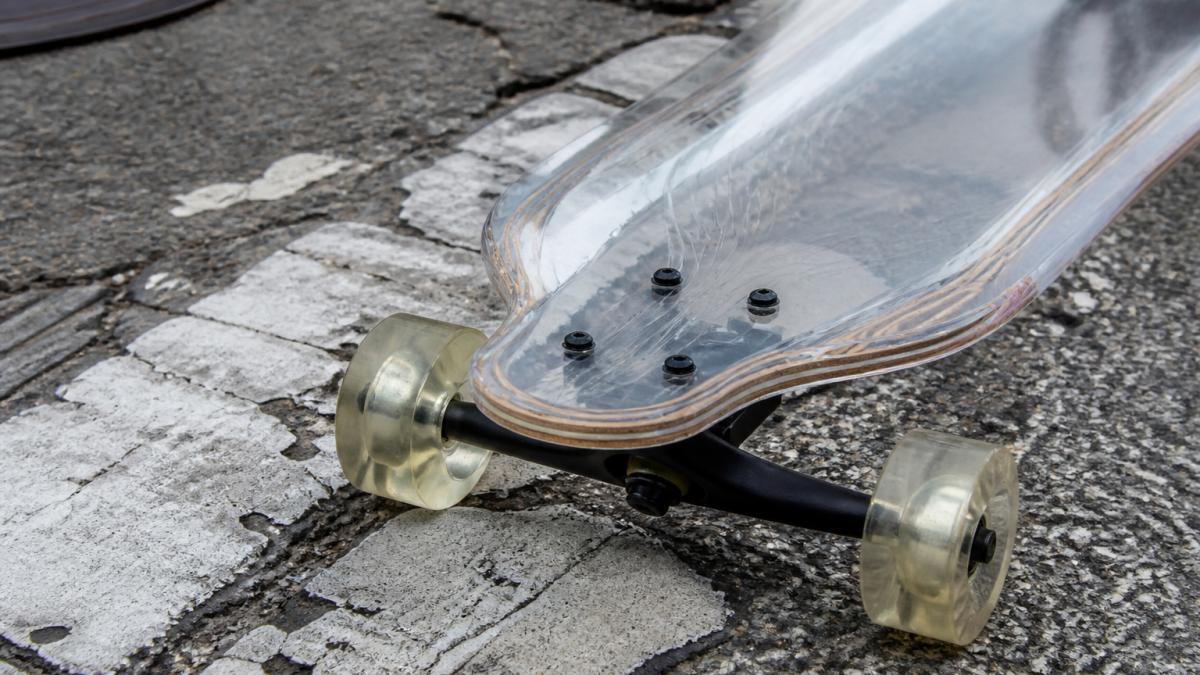
A 90-Day Commuting Test You Can Reproduce
Riders who track their boards log the same short loop weekly and inspect on a fixed schedule:
- Route: a 2-4 mile mixed loop with at least one rough-pavement stretch, one curb transition, and one smooth multi-use path.
- Frequency: 4-5 rides per week for 12 weeks (roughly 200-250 miles).
- Load: ride with your normal commuting load (backpack, lock, layers) so weight and vibration match real use.
Results vary with build quality and rider weight, but a logged baseline turns “it feels fine” into comparable evidence.
What to Inspect and What Each Finding Means
Inspect in this order, in good light, with the deck clean and dry:
- Wheel-mount and truck-mount zones. Look for hairline cracks radiating from bolt holes. Small, stable lines are common; lines that grow between inspections are the warning sign.
- Deck edges. Check where the acrylic meets the core. A thin, even bond line is normal. Lifting, whitening, or a visible gap means moisture can enter.
- Top and bottom surfaces. Scuffs and scratches are cosmetic. Cloudy patches or yellowing in clear acrylic point to UV exposure, not structural failure.
- Flex check. With the board on a flat floor, press the center with moderate hand pressure. A dull creak, a soft spot, or a change in stiffness versus your day-0 notes warrants a closer look.
- Core check. Tap the deck lightly along its length. A sharp, consistent sound is normal; a dead or hollow thud near a crack suggests separation inside.
Stop riding and inspect further if you find any of these: a crack that has visibly lengthened since your last check, edge separation you can catch a fingernail in, a soft spot underfoot, or a creak that appears only when weight is applied. These are the conditions under which an acrylic deck’s structural margin is no longer predictable.
Wear Patterns by Mileage Band
Riders who log their boards see a similar progression, though build quality and riding style shift the timeline:
- First 100-200 miles: cosmetic scuffing on the bottom, light scratching near the nose and tail from curbs and dismounts. No functional change.
- 200-500 miles: faint stress lines may appear around bolt holes on thinner decks. Stable lines are not a failure; growing lines are.
- 500+ miles: edge bond lines deserve monthly scrutiny, and any prior crack should be measured and photographed at each inspection.
A well-built acrylic commuter deck commonly stays rideable with the core bond and mount zones, not the acrylic face, usually determining end of service life.
When It Is No Longer Safe to Ride
Replace or retire the deck when any of the following is true:
- A crack has grown across two consecutive inspections.
- Edge separation exposes the core to water.
- The deck has lost stiffness in a localized area (a soft spot).
Epoxy or clear resin can slow a small, stable crack but doesn’t restore structural margin. Once a crack is moving, the deck is a maintenance item, not a commuter.
Durability is measurable. Log your route, inspect four zones on a fixed schedule, and retire the deck on growth or separation, not on appearance. That protocol answers the commuting question better than any spec sheet.
Best Longboard for Commuting: Acrylic Deck Features That Matter
Not all acrylic decks perform equally for commuting. Several design features separate boards that last from those that fail quickly.
Deck Length, Width, and Maneuverability
Commuting requires balancing stability and maneuverability. Explore the Layback Dropthrough Longboard to see how a dropthrough design delivers smooth cruising and stable riding.
Shorter decks (32-36 inches) maneuver better on compact city streets and are easier to carry on transit.
Width matters too. Wider decks (10+ inches) provide more foot space and stability. Narrower decks (8.5-9 inches) are lighter and easier to maneuver.
Stability for Beginner Riders
Acrylic boards can be stable platforms for beginners if designed correctly. The rigid layer provides consistent response with no flex surprises, helping new riders develop balance and confidence.
Beginners should look for:
- Wider decks for more foot space
- Longer wheelbases for directional stability
- Lower ride height (smaller wheels) for easier dismounting
Acrylic’s rigidity helps beginners: there’s no guessing how the deck responds to weight shifts, while a maple board’s flex can feel unpredictable to someone still learning.
Acrylic commuting decks come in standard sizes with different trade-offs for city riding.
| Deck Length | Best For | Trade-off |
|---|---|---|
| 32-36 inches | Compact city streets, transit carry | Less stability at speed |
| 38-42 inches | Rough pavement, smooth rides | Harder to turn, heavier |
| Width 8.5-9 inches | Lighter, easier maneuver | Less foot space |
| Width 10+ inches | Foot space, stability | Heavier, less agile |
| 9-9.5 inches wide | Most commuters | Sweet spot balance |
Longboard Weight Capacity: Deck Flex and Load Limits
Weight capacity is where acrylic decks show their limits versus maple. Acrylic doesn’t flex to absorb load like wood; it transfers weight and impact into the core and mount zones, making weight a structural question, not a comfort preference.
How to Verify a Manufacturer’s Weight Limit
Do not rely on a single number in a product description. Check these sources, in order:
- The printed spec or product page. Look for a stated rider weight limit and whether it includes cargo.
- The warranty language. A warranty that excludes “overloading” or “abuse” tells you the limit is a hard ceiling, not a suggestion.
- The deck construction details. Thicker acrylic over a quality plywood core generally carries more load than thin acrylic over a light composite.
- Customer support. Ask directly whether the limit assumes rider weight alone or rider plus carried gear.
If a seller cannot state a limit, treat the board as unsuited to daily commuting with cargo until you can confirm one.
Reading Flex on a Rigid Deck
Acrylic decks are stiff by design, so “flex” here means how the whole assembly behaves under load, not how much the face gives.
- Static check: place the board on a flat floor, stand in your normal riding stance, and have someone sight along the deck edge. A slight, even curve is normal. A sharp bend or a flat spot under one foot is not.
- Loaded check: repeat with your commuting load on your back. If the deck’s curve changes noticeably or you hear a creak only when loaded, the margin is thin.
- Mount-zone check: after riding, inspect bolt holes for stress lines. Load concentrates there first.
Weigh your full commuting kit once, including backpack, lock, and layers. Riders routinely underestimate carried load by 10-20 pounds, which is exactly the range where a deck near its limit starts to matter.
Load Distribution in Practice
Where weight sits matters as much as how much there is:
- Centered stance: spreads load between the trucks and reduces stress at any single mount zone.
- Stance over the trucks: common for stability, but it concentrates load at the bolt holes; inspect those zones more often.
- Rear-weighted stance with a heavy pack: shifts stress toward the tail and the rear mount zone.
If you routinely carry a heavy pack, consider a longer deck with more distance between the trucks to spread load, and keep your stance centered rather than pinned over one truck.
Who Should Choose Maple Instead
If you’re a heavier rider, carry significant daily cargo, or ride aggressively over rough pavement, a maple deck’s flex distributes stress more evenly and extends service life. Acrylic remains reasonable for riders comfortably under the stated limit who want the clear-deck look and will inspect on a schedule.
Find the stated limit, confirm whether it includes cargo, weigh your kit, and check flex under load. If the deck is near its ceiling, size up in length or switch to maple rather than riding at the edge.
Longboard Maintenance Tips for Acrylic Decks
Maintenance determines how long an acrylic deck lasts; regular care can extend lifespan by 6-12 months or more.
Cleaning and Storage Best Practices
Clean your acrylic deck weekly during regular commuting. Dirt and grime trap moisture and accelerate wear.
Cleaning steps:
- Rinse with fresh water to remove dirt and salt
- Wipe dry immediately with a soft cloth
- Never use harsh chemicals or high-pressure washers
Storage matters too. Store your board indoors in a cool, dry place; extreme temperature swings expand and contract the acrylic, stressing the core bond.
Avoid leaving your board in a hot car or direct sun for hours; UV exposure yellows acrylic and can weaken it.
Preventing Cracks and Extending Lifespan
The best way to extend lifespan is preventing cracks before they start.
Prevention strategies:
- Avoid riding on extremely rough pavement when possible
- Check wheels and bearings regularly, worn wheels increase impact stress
- Don’t land tricks or jump curbs (acrylic isn’t designed for impact abuse)
Small cracks caught early can be sealed with clear epoxy: clean the crack, apply epoxy, and let it cure fully before riding. This stops the spread but doesn’t restore full structural strength.
Common Misconceptions About Acrylic Longboards
Several myths circulate about acrylic durability. Knowing the truth sets realistic expectations.
Misconception 1: “Acrylic is fragile and breaks easily.”
Reality: Quality acrylic decks are durable for commuting.
Misconception 2: “LED lights and acrylic make boards too heavy to carry.”
Reality: Acrylic is slightly heavier than maple, usually by 1-2 pounds, and LED components add under 1 pound. Most riders don’t notice during commuting or carrying the board on transit.
Misconception 3: “Acrylic boards can’t handle rough pavement.”
Reality: Acrylic handles rough pavement fine. The material is rigid and resists deformation.
Choosing between acrylic and maple comes down to priorities.
Ghost Boards designs acrylic decks for commuters who value both aesthetics and performance. If you’re considering an acrylic board for daily commuting, understand your riding conditions, then choose the deck that matches your needs. Get started building your custom commuter board and discover how a thoughtfully designed acrylic deck can transform your daily ride.
Frequently Asked Questions
Are acrylic longboards durable enough for daily commuting on rough pavement?
Yes, acrylic longboards are durable for daily commuting when properly maintained. Acrylic offers strong impact resistance and handles rough pavement well, though it requires more care than traditional maple. The key is consistent maintenance, proper storage away from extreme temperatures, and using quality wheels and bearings.
How do acrylic and maple longboards compare for commuting?
Acrylic decks are visually striking, making them ideal for style-conscious commuters. Maple offers slightly better durability in extreme weather. Acrylic excels in stop-and-go city riding and portability for public transit connections. Maple provides more traditional flex and forgiveness.
What is the weight capacity of an acrylic longboard?
Capacity depends on deck thickness and construction. Thicker acrylic decks and reinforced construction handle higher weight limits. Exceeding the rated capacity increases flex, which stresses the material and raises crack risk. Check the manufacturer’s specifications, as weight limits vary by board design. Heavier riders benefit from stiffer acrylic formulations and reinforced core construction.
How do I prevent an acrylic longboard from cracking during commuting?
Avoid extreme temperature swings, store the board indoors away from direct sunlight, and inspect it regularly for small stress cracks. Use proper grip tape to distribute weight evenly, avoid standing in the same spot repeatedly, and don’t exceed the weight capacity. Ride on smooth surfaces when possible and avoid jumping or tricks if commuting is your only use. Regular maintenance and careful storage extend acrylic deck lifespan significantly.